
WorkNo. 05
Empik · independent concept
I made the delivered price part of choosing a book.
An independent Empik concept for a known edition and a delivery deadline. I built a working comparison that keeps condition and seller visible, recalculates the delivered total and explains why an offer fails the buyer’s choices. Public-site observations support the proposal; human research and commercial outcomes remain untested.
- Commerce evaluation
- Interaction design
- Experiment planning
The lowest item price leaves a question open
In the specimen below, a new book costs PLN 39. Delivered, it costs PLN 50.99, and its estimated arrival runs past Friday.
A second seller charges more for the book. Its arrival range is earlier. I invented both offers around a real title so that the decision could be inspected.
I built this independent concept for a buyer who already knows the edition and needs it by a particular day, and the design keeps that edition in view while they compare condition, seller and the amount payable for the delivery method they’ve picked. The comparison can also end honestly: none of the available offers may meet the requirement.
My evidence is a small anonymous inspection of Empik, on desktop and at a 390-pixel phone width. It covered:
- search
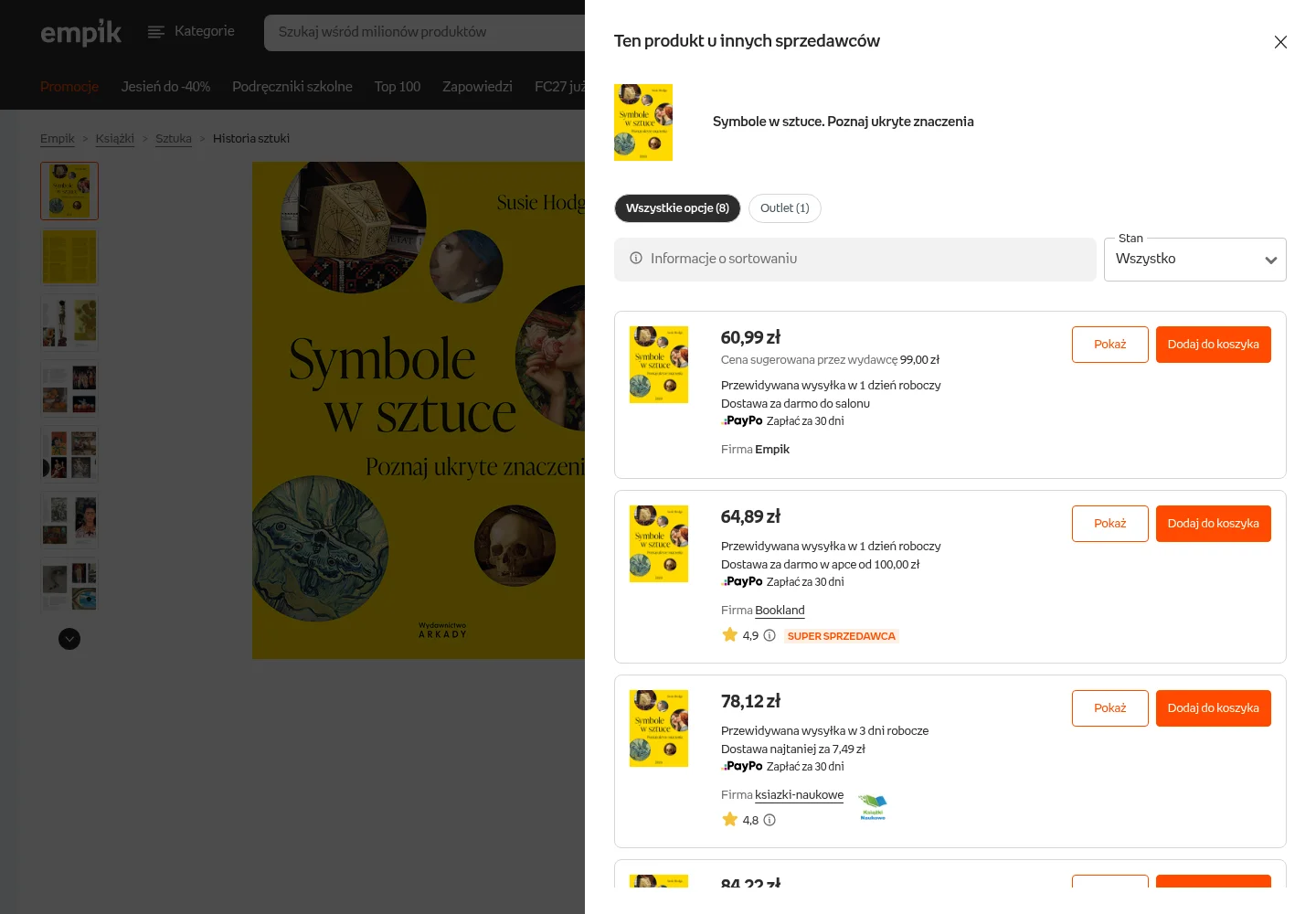
- one art-history book and the offers from its sellers
- the delivery information
- the basket
I had no customer interviews, internal analytics or orders, so what this case offers is a working proposal and an evaluation plan without a measured conversion result.
Fig. 1 Interactive exhibit
What the inspection actually established
Open a record to see the observed interface, the question it raises and the decision it supports.
Dispatch and arrival appeared in different places
The product displayed dispatch in one working day. The delivery drawer described another 1–2 working days after dispatch.
- Basis for the decision
Product and delivery captures from the anonymous browser inspection.
- Design response
The proposal labels the arrival range separately. Research must establish whether the original wording causes a buying error.
Seller delivery messages were conditional
The inspected offers used different claims, including free salon collection, app-dependent thresholds and delivery starting at a stated charge.
- Basis for the decision
Eight offers were inspected. This is a presentation sample, without seller or order data.
- Design response
Compare totals for one selected method. A benefit with unmet conditions cannot reduce the current total.
The mobile product offered two buying routes
The bottom action area gave prominence to adding to basket and buying more cheaply in the app. Premium appeared in another delivery message.
- Basis for the decision
The mobile capture records the visual hierarchy. It does not record a participant reaction.
- Design response
Keep the browser total explicit. App and membership acquisition need separate commercial evaluation.
Guest checkout remained unverified
The checkout entry offered sign-in and “Kup bez rejestracji.” Inspection stopped at that entry; payment and confirmation screens were not inspected.
- Basis for the decision
No purchase, personal-data submission or human checkout study occurred.
- Design response
The working artifact ends at offer selection. It makes no claim about the quality of later checkout screens.
Different delivery messages justify investigating comparison. They do not establish an Empik-specific abandonment rate or prove that a larger comparison interface is necessary.
I narrowed the work to a comparable offer
The first brief reached from discovery all the way to checkout. Finding a book and paying for it go wrong for different reasons, and if I’d changed both at once, I couldn’t have told which change helped. So the working prototype covers one decision. The question is which seller to buy from, with one book and one copy held constant.
In this model an offer is four things: the requested edition, the copy’s condition, a seller and a quote for the chosen delivery method. Its price is the book amount plus that delivery charge. The fixture has no membership, app coupon or payment promotion, which keeps every example answerable, though a production version would need the real rules for each benefit and fulfilment group.
The title, Susie Hodge’s name and the hardcover binding come from the inspected product, while the seller identities, prices, fees and arrival ranges in the prototype are all fictional. The record points to that page and doesn’t invent an ISBN. Matching editions for real would take a verified identifier and catalogue reconciliation before another seller’s copy could join the same comparison.
I check a deadline against the end of the estimated range
An offer estimated for 16–19 October doesn’t qualify for arrival by 16 October. If I took the first day of the range, I’d hide exactly the uncertainty the buyer has to judge.
The rule is conservative. Its cost is that an offer that might arrive on Friday sits below the qualifying choices. The range stays visible, though, and the buyer can remove the deadline. The interface never turns an estimate into a guarantee.
Fig. 2 Interactive exhibit
Choose a copy for the date you need
Start with a new copy delivered by Friday. Compare the item price with the delivered total, then try collection or include used copies.
Independent concept. Seller names, prices, fees and dates are illustrative fixtures. No live availability or purchasing.
Offer comparison · fixed scenario
A book for Friday.
Keep the requested edition. Choose how to receive it, set an arrival deadline and decide whether a used copy is acceptable.
Symbole w sztuce. Poznaj ukryte znaczenia
Requested edition
Polish, hardcover, one copy
Specimen E01 · edition stays fixed across all offers
Title, author and binding come from the inspected product. Offer and logistics data below are fictional; an ISBN is not verified in this prototype.
Comparable offers
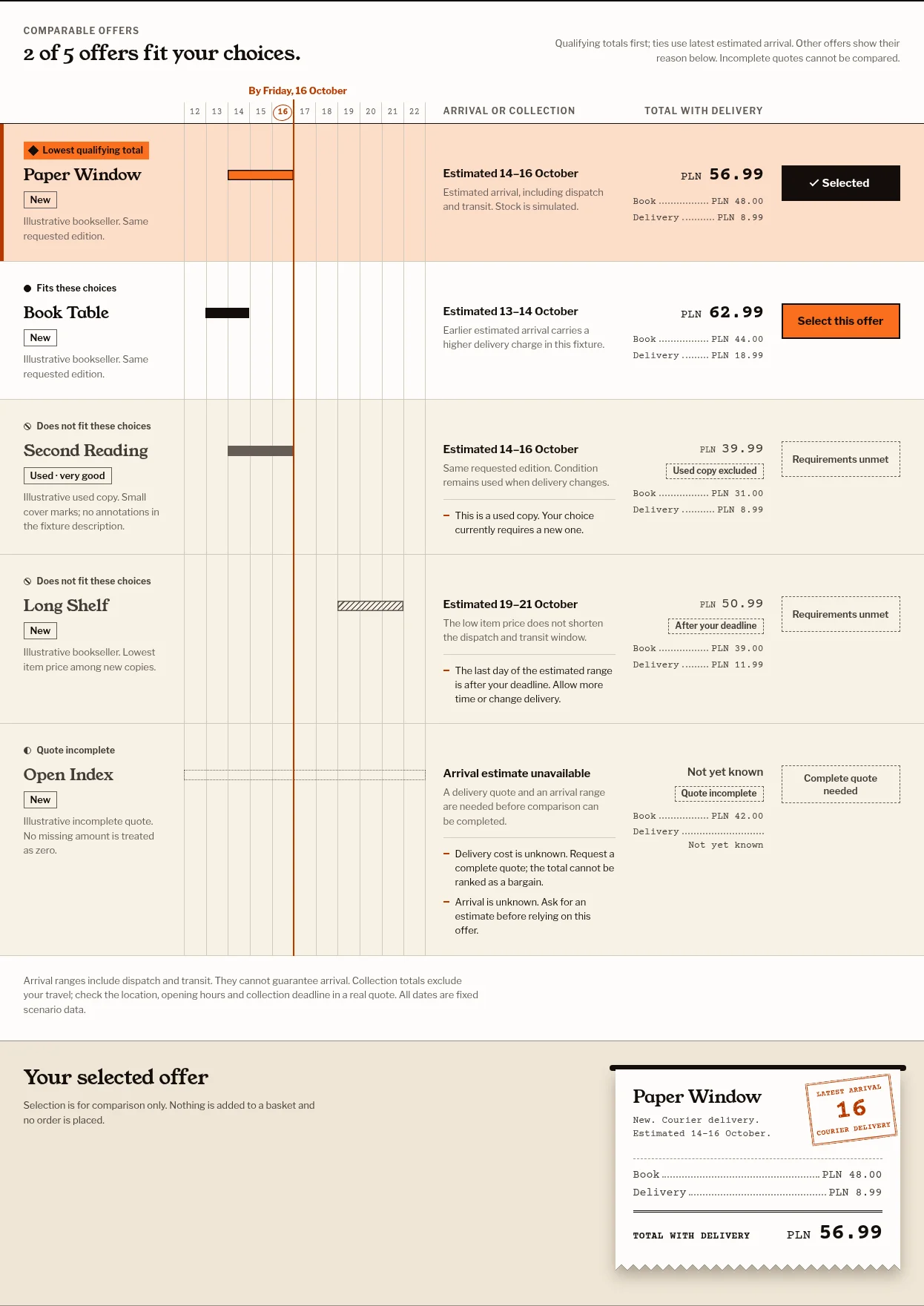
2 of 5 offers fit your choices.
Qualifying totals first; ties use latest estimated arrival. Other offers show their reason below. Incomplete quotes cannot be compared.
No offer fits all your choices.
The remaining offers explain what is missing or incompatible. You can change the deadline or delivery method. Keeping your requirements is also a valid decision.
Lowest qualifying total
Paper Window
New
Illustrative bookseller. Same requested edition.
Arrival or collection
Estimated 14–16 October
Estimated arrival, including dispatch and transit. Stock is simulated.
Total with delivery
PLN 56.99
- Book
- PLN 48.00
- Delivery
- PLN 8.99
Fits these choices
Book Table
New
Illustrative bookseller. Same requested edition.
Arrival or collection
Estimated 13–14 October
Earlier estimated arrival carries a higher delivery charge in this fixture.
Total with delivery
PLN 62.99
- Book
- PLN 44.00
- Delivery
- PLN 18.99
Does not fit these choices
Second Reading
Used · very good
Illustrative used copy. Small cover marks; no annotations in the fixture description.
Arrival or collection
Estimated 14–16 October
Same requested edition. Condition remains used when delivery changes.
- This is a used copy. Your choice currently requires a new one.
Total with delivery
PLN 39.99
Used copy excluded
- Book
- PLN 31.00
- Delivery
- PLN 8.99
Does not fit these choices
Long Shelf
New
Illustrative bookseller. Lowest item price among new copies.
Arrival or collection
Estimated 19–21 October
The low item price does not shorten the dispatch and transit window.
- The last day of the estimated range is after your deadline. Allow more time or change delivery.
Total with delivery
PLN 50.99
After your deadline
- Book
- PLN 39.00
- Delivery
- PLN 11.99
Quote incomplete
Open Index
New
Illustrative incomplete quote. No missing amount is treated as zero.
Arrival or collection
Arrival estimate unavailable
A delivery quote and an arrival range are needed before comparison can be completed.
- Delivery cost is unknown. Request a complete quote; the total cannot be ranked as a bargain.
- Arrival is unknown. Ask for an estimate before relying on this offer.
Total with delivery
Not yet known
Quote incomplete
- Book
- PLN 42.00
- Delivery
- Not yet known
Arrival ranges include dispatch and transit. They cannot guarantee arrival. Collection totals exclude your travel; check the location, opening hours and collection deadline in a real quote. All dates are fixed scenario data.
Your selected offer
Selection is for comparison only. Nothing is added to a basket and no order is placed.
Choose an offer that fits.
- Book
- Delivery
Total with delivery
With courier delivery by Friday, two new copies qualify. Book Table has the lower item price. Its delivered total is higher: PLN 62.99 against Paper Window’s PLN 56.99. Book Table also has the earlier estimated window. The list shows the arithmetic and keeps the timing difference beside it, so “cheapest” can’t stand in for every buying preference.
A used copy only becomes eligible once the buyer accepts that condition. The requirement changes in the open, and the edition stays the same.
Open Index has an attractive item amount and an incomplete delivery quote, so it can’t enter the qualifying ranking. The missing information stays beside that seller with a next step. It’s never converted into a free delivery fee.
Bring the selected delivery into the comparison
The original capture records seller messages from one public product. The proposal aligns condition, arrival and delivered total for a controlled scenario. The two sets of prices aren’t a before-and-after comparison.
Empik did not commission or endorse this work. The proposal is an independent design exercise; it establishes no improvement in paid orders.
A larger interface has to earn its place
A comparison list makes differences visible. It also gives people more to read. Someone buying from a seller they already know might only need a clearer summary on the product page.
I kept that smaller intervention in play as a serious alternative and held it to the same decision requirements, since liking how the list looks would be a poor reason to choose the more expensive integration.
Fig. 5 Interactive exhibit
Three ways to assemble the same buying decision
Compare the placement of the decision, the data each concept needs and the cost accepted by the prototype.
Put a complete offer beside purchase
Keep the product structure. Assemble seller, condition, selected delivery and payable total into one summary.
- Basis for the decision
Different delivery messages motivate collecting the information in one place.
- Design response
Prefer this if people can choose correctly without repeatedly comparing sellers. It retains navigation between alternative offers.
Align comparable offers in one list
Keep the edition fixed and compare selected-method totals. Show why each remaining offer misses the buyer’s choices.
- Basis for the decision
The executable fixture exposes total-price reversals, late arrival and missing quote data.
- Design response
Built here because the decision rules can be inspected. Choosing it for production depends on recurring comparison errors and reliable quote data.
Ask for delivery before browsing offers
Carry a method and deadline through the journey, showing suitable offers earlier.
- Basis for the decision
This could reduce repeated entry for a buyer with a firm date; that benefit remains hypothetical.
- Design response
Defer this direction until research shows that early delivery input helps. It asks an exploratory shopper to commit before understanding the assortment.
The working artifact explores B. A remains the lower-cost production candidate until real tasks show that cross-seller comparison needs more space.
I order the list by an explicit, limited rule
Qualifying offers come first, ordered by their known total for the selected method. A tie is broken by the last day of the estimated arrival range. The remaining offers stay below with their amounts and explanations.
Anyone can trace the result, but within the accepted constraints it favours price. The earlier-arriving alternative stays on the list, and a study with people has to check whether buyers still notice it. Sponsored placement would need a visible label and its own rule. This fixture has no advertising.
Changing a choice should change the explanation
Switch to collection, and the charge, the wording of the date and the available sellers all change. In this proposal, delivery belongs to the offer itself.
If the selected offer still qualifies, it stays selected. If it stops qualifying, the summary asks for a new choice and the seller’s row explains the mismatch.
Fig. 6 Interactive exhibit
Follow a selection through a change
Move through the states in this controlled walkthrough, then reproduce them in the working comparison above.
Select Paper Window for courier delivery
New copy, arrival by 16 October. Book PLN 48 plus delivery PLN 8.99 gives PLN 56.99.
- Basis for the decision
The fixture’s latest estimated arrival is 16 October, so it qualifies.
- Design response
The summary repeats seller, condition, method, range and delivered total.
Switch the same choice to collection
Paper Window offers free collection with an estimated ready range of 13–14 October. Its total changes to PLN 48.
- Basis for the decision
The seller and condition remain compatible. The exact edition is still held constant.
- Design response
Keep the selection and update the summary. Announce the revised result without moving keyboard focus.
Move the deadline to 13 October
No new collection offer qualifies. The 13–14 October range cannot promise readiness by the 13th.
- Basis for the decision
The upper-bound rule produces an empty qualifying set; the excluded offers remain readable.
- Design response
Clear the incompatible selection and explain why. Offer removal of the deadline or a change of delivery method.
Remove the deadline and compare again
More offers become eligible, including the slower new copy. A buyer may still keep the deadline and leave without choosing.
- Basis for the decision
Relaxing a requirement changes the result. It does not change the estimate into a guarantee.
- Design response
Require a deliberate new selection. Reset restores the original buying conditions.
On a phone, each row becomes a complete vertical record. A few implementation decisions sit behind that layout:
- The price keeps its own place beside the seller; arrival and the reason for exclusion follow in reading order.
- Native selects and buttons support keyboard operation.
- Result changes use a polite announcement.
- No overlay or sticky purchase control covers the comparison.
All four still need verifying, and none of them amounts to a claim of universal accessibility.
Synthetic critique can challenge the rules
I asked an AI reviewer to test the rules from four deliberately different positions:
- a buyer working to a deadline
- a buyer on a budget who’s willing to collect a used copy
- a buyer unfamiliar with marketplaces
- someone changing delivery by keyboard
These were constructed perspectives; no persona research took place. The reviewer received the mechanics and the fixture answers. It never observed people using the interface.
It challenged the deadline wording, the incomplete quotes and the lost context when a choice stops qualifying. I changed the prototype in response:
- The conservative date rule now sits beside its control.
- Incomplete quotes carry their own label.
- After a selection is cleared, the previous seller stays marked.
- The collection limits and the reset destination are explicit.
These changes answer a review of specified mechanics. Comprehension and trust still need observed tasks with people.
A separate AI review looked at the actual desktop screenshot. It found a visual conflict: excluded low totals carried the same weight as qualifying ones. I reduced their emphasis, put a compact exclusion beside each affected total and gave disabled choices a distinct label. The restriction now sits close to the amount that could attract attention, and whether buyers notice it is a question for the human study.
I would compare correct decisions before conversion
Before anyone counts orders, I’d want to know whether buyers make the right choice. The plan starts with the interface as it is.
First, six sessions with the current interface
The next research round would begin with six moderated baseline sessions. I’d recruit Polish-speaking people who’ve recently bought books online, across purchase frequency and digital confidence. Their tasks would ask for a specified edition, a delivered total and a choice for a given deadline, and a pilot would check the wording first. No one would be asked to pay. A simulated basket would replace any task that approached a transaction.
Those sessions should establish whether the comparison problem recurs. If the current interface already supports correct decisions, I’d reduce the proposal. If catalogue ambiguity causes the failures, the first intervention belongs in edition identity, because a clearer list can’t repair an unreliable catalogue or a missing delivery quote.
Then a comparison with the proposal
Only after that baseline would I run a directional comparison with 12 new participants. A faithful reconstruction of the current interface and the proposal would use matched scenarios of equivalent seller and delivery complexity. Four balanced sequences would vary which version and scenario each person sees first. That reduces some order effects. Learning stays a limit of the study.
What counts as a correct decision
The answer key would accept the intended edition and condition, a qualifying delivery choice and the correct total. It would equally accept the correct recognition that no offer qualifies. I’d record assistance and arithmetic errors separately. Each task would be timed from reveal to final answer, with its completion status beside it, so a fast wrong choice would remain a failure.
The gate for going further
My provisional design gate is that at least 10 of 12 participants explain the knowable total and the edition and condition choice correctly, with no unresolved false promise about price or arrival. Two people repeating the same serious misunderstanding would send the design back for revision.
These are local criteria for the next design decision, and they wouldn’t estimate population preference or establish a commercial effect.
A production experiment needs reliable quotes and an owner
A real test would need Empik’s participation. It would also need an agreed implementation and authoritative order data. My first job would be an audit of the events from product entry through comparison, basket and checkout to the paid order, including retries and orders from several sellers. GOV.UK’s completion guidance is a useful discipline here, for deciding where a transaction begins, where it ends and what enters the denominator.
The first experiment should isolate the selected offer summary from any change to search, promotions or checkout. Microsoft’s experimentation guidance supports a falsifiable hypothesis, suitable assignment and data-quality checks. For this proposal, that comes down to three rules:
- Eligibility is decided before rendering.
- Each visitor keeps a persistent assignment.
- Every eligible assigned visitor stays in the analysis, including people whose comparison failed to load.
A candidate primary measure is the share of eligible assigned visitors with a paid physical-book order within seven days of first eligibility, and the analysis would wait for those outcome windows to mature. Contribution per eligible visitor, cancellations and delivery-related contacts would constrain a commercial decision, alongside quote errors and page responsiveness. Seller distribution and any displacement of app or Premium purchases would need owner review.
I haven’t set a sample size or duration. Both depend on a baseline and an acceptable commercial loss, and neither is available. The owner would need to agree both before launch, then define a staged rollout and rollback triggers. A readable comparison still wouldn’t be fit for release if quote accuracy failed or the commercial guardrails worsened.
If complete quotes can’t be supplied, I’d carry the smaller product summary forward and defer the full list.